Getting a lead is just the beginning, as the real challenge starts later: get them to respond, spark their interest, and transform that contact into a real business opportunity..
This problem is especially evident in telemarketing campaigns. A company may have thousands of potential contacts, but if the call comes at a bad time, the user doesn't recognize the company, or they don't know why they are being contacted, the chances of starting a sales conversation are reduced.
“"What if we could prepare the lead before making the call?"”
Here's a particularly interesting strategy: combine RCS and telemarketing within the same sales process.
Throughout this article we will see how to design this strategy step by step, some examples and different ways to use RCS to turn a simple contact into a much more qualified business opportunity.
The problem with calling a lead too soon
Let's imagine that a person has just registered to request information about a new electricity tariff, their data reaches the sales team and, a few minutes later, they receive a call.
It might work.
But many other things can also happen: they're working, they don't recognize the phone, they're not yet familiar with the company, they want to compare alternatives, or they're simply not ready for a conversation. The lead exists, but The market timing is not yet right..
A combined strategy introduces an intermediate step:
Lead → RCS message → interaction → sales call
The message can briefly present the proposal and offer different actions, and it is here that user interaction provides an additional signal about their interest before an agent intervenes.
The goal is not to replace the call, but to ensure it arrives with more context.
RCS as a preliminary step to telemarketing
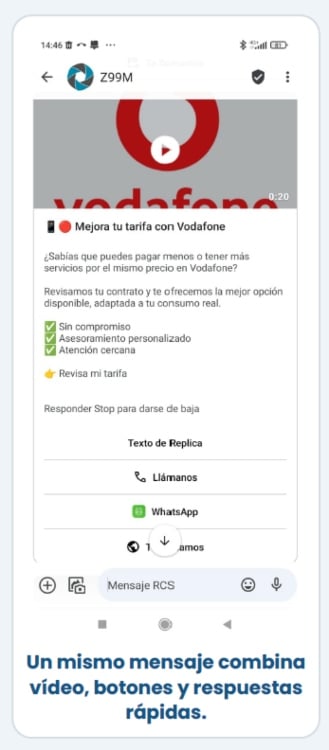
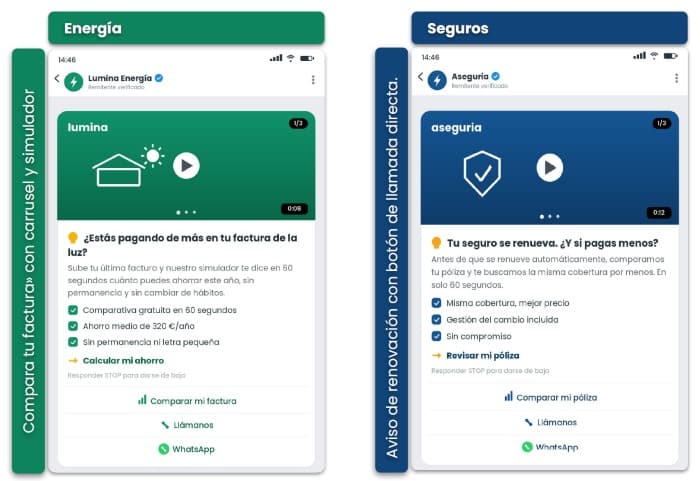
RCS (Rich Communication Services) It expands the possibilities of traditional mobile messaging by incorporating, in compatible services and devices, elements such as images, buttons, suggested replies, multimedia content, and corporate identity.
These features allow for much more action-oriented communications.
- Instead of sending: “We have an offer for you. We will call you soon.”
- We can design an experience that allows the user to choose between options such as:
- I want to know the offer
- I prefer that you call me
- More information
- I'm not interested now.
From a business perspective, the difference is important because the second scenario not only communicates: generates information about the lead's intent.
Examples of RCS communications:
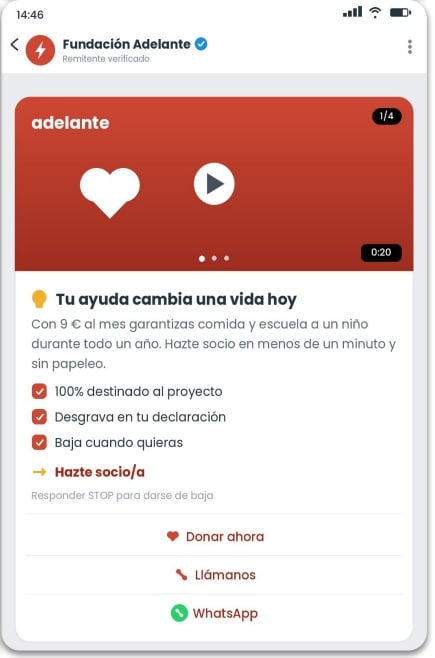
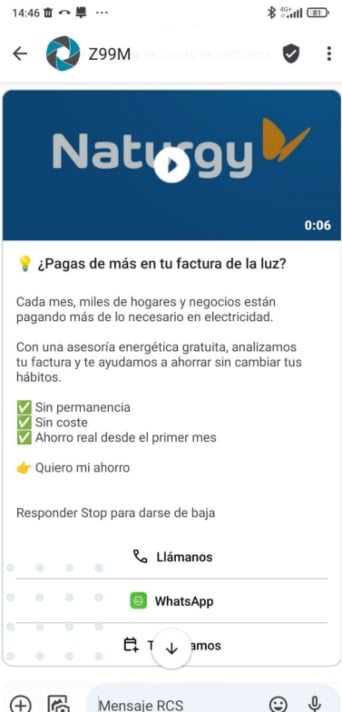
The call changes when we know the prior interest.
Let's compare two calls:
In a traditional campaignl: “Hello, I’m Laura from company X. I’m calling because we have an offer that might interest you…”
Now let's imagine that The user has previously clicked on RCS about “I want information about 1 Gb fiber”.
- The agent has context and can adapt the conversation"Hello, Javier. You requested information about our 1 Gb fiber option, and I'm calling you to answer any questions you may have and check the available options."“
The difference isn't just in the message, it's in continuity between channels and the % closing.
How to design an RCS + telemarketing strategy
For the combination to work, both channels should not be managed as independent campaigns., They need to be part of the same business route.
1. Start with good segmentation
Before sending any message, we must determine who we want to contact.
A properly normalized and enriched database It can allow you to create segments using variables relevant to each campaign.
- In B2B These could be sector of activity, CNAE code, company size or location.
- In energy Certain supply characteristics or customer profiles could be used when such information is legitimately available.
- In telecommunications There may be variables related to customer type, contracted services, or connectivity needs.
2. Use RCS to present a simple proposal
The first contact should not attempt to explain the entire offer; its main objective is to generate action.
A simple structure could be:
Problem or benefit → proposal → call to action
For example:
“Are you thinking about improving your business's connectivity? Discover our fiber optic solutions for businesses.”
And offer two options:
- View solutions
- I want them to call me
The fewer unnecessary decisions we introduce, the easier it will be to interpret the user's intention.
3. Turn every interaction into a trading signal
Clicking “More information” does not necessarily express the same intention as clicking “I want them to call me.” Therefore, a simple system can be established to lead scoring.
For example:
- Request call → high intent.
- Check prices → high intent.
- View information → average intent.
- Open without interacting → weak signal.
- Rejecting communication → exclusion from the corresponding flow.
Each company should build its lead scoring model using its own historical conversion data.
4. Prioritize calls based on intent and timing
One of the biggest mistakes in telemarketing is treating all records as if they had the same value.
If 10 users have just requested information and another 100 have not shown any interaction for days, it may make commercial sense to establish different priorities.
Technology allows the use of signals for organizing call queues and help the sales team dedicate their time first to the opportunities with the greatest observable interest (especially in situations with a high volume of leads).
5. Give the agent the RCS context
The information generated by the campaign should be sent to the CRM or the tool used by the sales team. This way, the agent could know:
- What communication did the lead receive?.
- Which product did you inquire about?.
- Which button did you select?.
- When did the interaction take place?.
- What information had I previously requested?.
This way we avoid one of the biggest problems with multichannel strategies: that Each channel appears to belong to a different company..
RCS can also be used after the call
The combination does not always have to follow the order RCS → call, it can also work the other way around.
Imagine an agent is having a conversation with a potential client who wants to review the proposal before making a decision. Instead of relying solely on the agent to remember everything discussed, the agent can continue the conversation through a suitable digital channel, always within the applicable terms and permissions.
This allows us to think about broader routes:
RCS → call → additional information → follow-up → conversion
Marketing ceases to be a succession of independent impacts and becomes a conversation distributed across different channels.
The quality of the database can determine the result
RCS can be very advanced and a telemarketing team can be perfectly trained, but both start from the same element: the data.
A database with incorrect phone numbers, duplicates, outdated information, or poor segmentation reduces the potential of any strategy. Therefore, before launching a campaign, it's essential to... It is recommended to work on 3 processes:
- Standardization: correct and standardize the records.
- Enrichment: incorporate useful variables to better understand and segment contacts when appropriate.
- Segmentation: create specific audiences for each offer, message, and sales journey.
Lead to Win: Data as a starting point for improving conversion
In Lead to Win We work with companies that need to improve their processes data collection, segmentation and commercial exploitation.
Our database services, normalization and enrichment They allow you to prepare information to develop more precise campaigns in sectors such as energy, telecommunications, insurance, NGOs and B2B, among others.
If you are considering incorporating RCS, telemarketing, or a strategy that combines both channels, we can help you work on one of the fundamental pieces of the project: to have a properly segmented database prepared for commercial action.