The way companies communicate with their customers has changed considerably.
For a company, the question should no longer be simply “Which channel should I use?”, but something more interesting: Which channel is most suitable for each type of communication and each moment in the customer relationship?
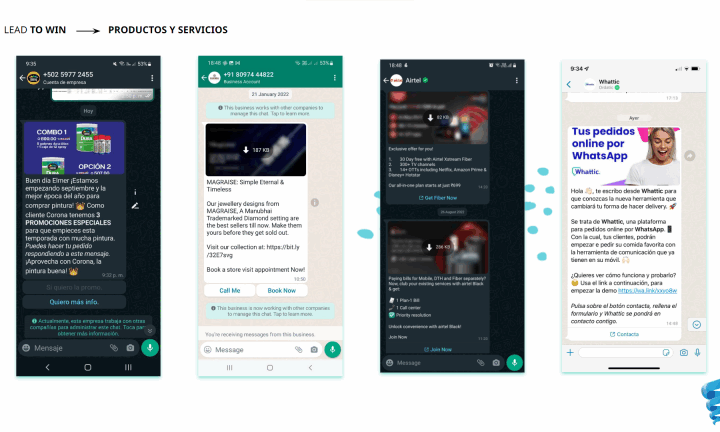
SMS, WhatsApp and RCS They can be used to send commercial communications, notifications, reminders, or service-related information, but there are important differences in reach, user experience, interactivity, and automation possibilities.
Next you will discover when to use each channel and how to best take advantage of its possibilities.
SMS, WhatsApp and RCS: three different ways to reach the customer's mobile phone
Although all three channels allow communication using the mobile phone as a point of contact, they work differently technologically.
- He SMS It's the simplest. It allows you to send messages directly to a phone number, and virtually any mobile phone can receive them.
- WhatsApp It works within its own application. Users must have WhatsApp, and businesses can use WhatsApp Business solutions to manage conversations, notifications, and certain business processes.
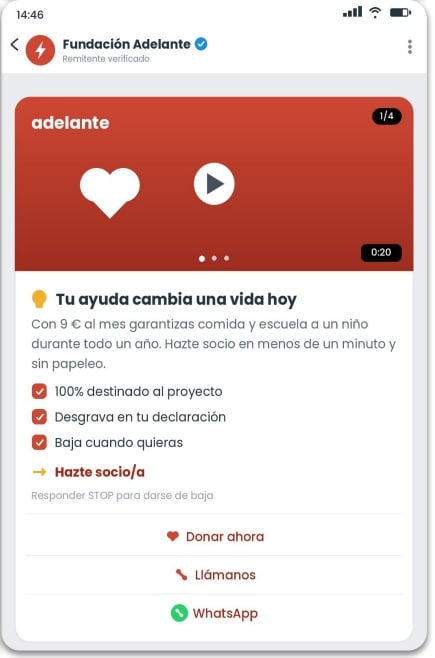
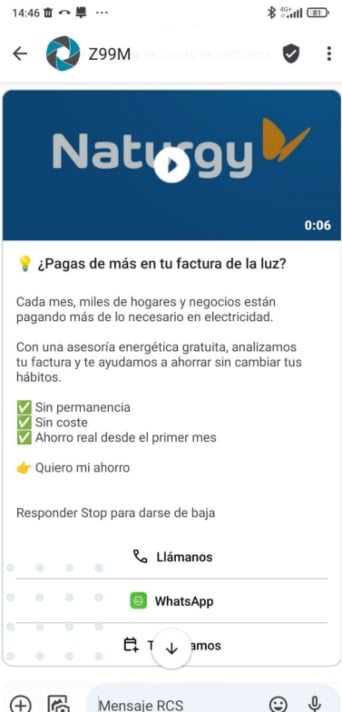
- He RCS (Rich Communication Services) It can be understood as an evolution of traditional mobile messaging. It allows the incorporation of elements typical of modern applications—images, videos, buttons, carousels, or suggested replies—within the phone's compatible messaging experience.
This seemingly small difference considerably changes the commercial possibilities of each channel.
What is RCS and why is it gaining importance?
RCS stands for Rich Communication Services.
Their goal is modernize the traditional messaging experience incorporating features that until recently we mainly associated with applications like WhatsApp.
For business communications, RCS can offer experiences with:
- Images.
- Videos.
- Action buttons.
- Suggested answers.
- Product carousels.
- Company visual identity.
- Read confirmations in compatible scenarios.
- Interactive conversations.
To understand its potential, we can imagine the same commercial message sent using two technologies.
A SMS I could say:
“Renew your plan. Check out our new offer here: [link]”.
An RCS experience could display the company's identity, an image of the offer, different fare options, and buttons such as “View offer”, “QI want information.” either “Talk to an advisor”.
The business objective may be exactly the same, but the user experience changes radically.
SMS vs WhatsApp vs RCS: Main differences
Feature | SMS | RCS | |
You need a specific app | No | Yeah | Not necessarily; it depends on compatibility |
Text messages | Yeah | Yeah | Yeah |
Images and advanced multimedia content | Very limited | Yeah | Yeah |
Interactive buttons | Not natively | Yeah | Yeah |
Two-way conversation | Limited | Yeah | Yeah |
Enriched corporate identity | Limited | Yeah | Yeah |
Read receipts | Generally not | Yeah | You can offer them |
Visual retail experiences | Limited | Highs | Highs |
Compatibility dependency | Very low | WhatsApp user | RCS Device, Operator and Service |
Main strength | Scope and simplicity | Conversation | Interactivity in native messaging |
Therefore, there is no universally superior channel; each one solves a different problem.
When should RCS be used?
RCS is especially attractive when a company wants combine the reach of mobile messaging with a visual and interactive experience.
It may have interesting applications in sectors such as:
- Retail: product presentations, promotions, or collections.
- Telecommunications: tariff renewals, portability, or service contracting.
- Energy: submission of offers, switching or contracting of new services.
- Insurance: renewals, policy information, or communications with clients.
- Automotive: reminders, reviews or submission of offers.
- Ecommerce: order information, recommendations, or promotions.
The database remains the starting point
We can have the best messaging technology on the market and still get poor results if the information used to contact users is deficient.
An SMS, WhatsApp, or RCS strategy It needs a properly managed database.
Before launching a campaign, it's worth asking yourself:
- Are the phone numbers correct?
- Do we have duplicate records?
- Do we know where each contact comes from?
- Can we segment users by interests or relevant characteristics?
- Is the data up to date?
- Do we have the legal authority to make the communication?
A campaign sent to 10,000 poorly segmented contacts can be much less profitable than one directed at 2,000 correctly identified profiles.
«"The quality of the data determines the quality of the communication."»
Importantly, they must also comply with the regulations
When we talk about commercial communications in Spain, we must pay special attention to the regulations on data protection and electronic communications.
The LSSI It establishes, in general terms, that electronic commercial communications must have been previously requested or expressly authorized, However, it does address certain situations arising from a prior contractual relationship for similar products or services. Furthermore, recipients must be provided with a simple and free mechanism to opt out of promotional communications.
In addition to this the GDPR and the LOPDGDD when personal data is processed.
For this reason, before designing a campaign, it is advisable to review not only what technology we are going to use, but also the origin of the data, the legal basis for the processing, the purpose for which it was obtained, and the possibility of proving the process.
Importantly, they must also comply with the regulations
Since September 2026, the new system related to the alphanumeric alias registration used in certain messages, within the measures intended to combat identity theft and fraud through messaging.
For companies that use SMS and other affected systems, this adds another issue to review within their communication processes: It is not enough to optimize the campaign from a commercial point of view; it is also necessary to keep the technical and regulatory requirements of the channel used up to date..
From data to a smarter communication strategy
In Lead to Win We understand that a good campaign starts long before sending the first message.
Database normalization, enrichment, and segmentation It allows you to better understand your audiences and develop more precise marketing actions.
Working on data quality can help identify segments, reduce low-value records, and focus sales efforts on truly relevant contacts.
Therefore, if your company is considering new campaigns using SMS, WhatsApp, RCS, telemarketing, or other channels, the first step might be to review something much more basic: Is your database ready to take advantage of them?
A properly developed foundation transforms the messaging of a mass campaign into a much smarter business strategy.