Your company generates leads, the sales team makes calls, sends quotes, and dedicates hours to managing opportunities. However, sales aren't coming in at the expected rate.
In a situation like this, it's common to question the quality of the contacts or consider investing more budget in lead generation. But Having many leads and few sales doesn't necessarily mean you're attracting the wrong people.. To understand why your leads aren't converting, you need to identify when they stop progressing and what's causing that blockage.
These are 8 possible reasons which should be reviewed before increasing investment in customer acquisition:
1. You are capturing leads that do not fit your target audience
One of the reasons why leads don't become customers is that lead generation is reaching profiles with few possibilities real of purchase.
To detect it, it is advisable to review what characteristics the contacts who end up buying share and compare them with those who are discarded.
- In B2B campaigns The sector, the size of the company, its location, or the type of need may be relevant.
- In B2C campaigns, The criteria will depend on the product and the target audience.
If a high proportion of the contacts are discarded due to lack of fit, you should probably Review the sources of acquisition, the segmentation criteria, and the messages used to attract them.
2. The recruitment message creates false expectations
Getting someone to fill out a form doesn't mean that person is interested in hiring. A campaign can have a very competitive cost per lead because it uses an attractive message, but one that is too far removed from the actual commercial proposition.
- ExampleAn advertisement promising to reveal how much you can save on your energy bill might attract users who simply want to ask a question. If they then receive a call to sign up for a service without having previously understood the purpose of the form, objections or rejection are likely to arise.
They are not necessarily low-quality leads, but there may be a difference between what they expected to receive and what the company offers them.
“The key is to maintain consistency between the ad, the landing page, the form, and the first sales contact.”
3. Contact details are incorrect or outdated
Incorrect phone numbers, unused email addresses, duplicate records, or incomplete information create unnecessary work and hinder sales follow-up. And in B2B campaigns, another problem arises: the data may belong to someone who no longer works at the company or whose responsibilities have changed.
Before attributing poor performance to a lack of interest, analyze what proportion of records contain valid information and how many contacts are lost due to data-related problems.
The processes of database normalization and enrichment They help improve consistency, detect errors, and complete information relevant to segmentation, provided that the processing of data has an adequate legal basis.
4. You take too long to contact leads
When a person requests information, they are focusing their attention on a specific need at that moment.
If the company takes too long to respond, that situation may change. because perhaps the user has already spoken to a competitor, resolved their doubt through another means, or has simply stopped considering the purchase a priority.
There is no single optimal response time for all sectors; the important thing is adapt the sales process to the intention and urgency of each contact.
To identify this problem, analyze how much time elapses from when a lead is generated until the first contact attempt is received and, above all, until the first effective conversation takes place.
If recent leads convert significantly better than those that have been pending for several days, it's a sign that your lead management speed needs review. One practical measure is to establish maximum response times according to the origin and priority of the contact, accompanied by alerts to prevent requests from going unanswered.

5. Your leads are not responding to sales calls
In campaigns that rely on telemarketing, the low contactability This can become one of the main obstacles to converting leads into sales.
The causes are diverse:
- Calls made at inappropriate times
- Unknown numbers
- Identified as spam
- Retry strategy that does not adapt to the recipient's availability.
When The problem lies in contactability., It's worth investigating time zones, phone status, and caller ID. Combining different communication channels can also be useful, provided there's a legal basis for doing so and the recipient's preferences are respected.
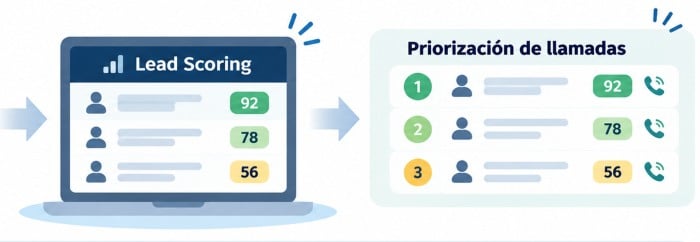
6. You treat all leads as if they are ready to buy
Two people can request information about the same product and be at completely different stages of their decision-making process. One wants to sign up within the next few days, while the other is researching alternatives and doesn't yet have a confirmed budget.
If both immediately receive the same closing pitch, the second is unlikely to move forward, even though they may become a customer later.
This is one of the problems that arise when companies fail to differentiate between a lead that has shown interest and a truly qualified opportunity.
In marketing and sales, the concepts of MQL (Marketing Qualified Lead) and SQL (Sales Qualified Lead) to distinguish contacts that meet criteria of interest and fit from those that already meet the defined conditions to be worked on as business opportunities.
The specific classification will depend on each business; the mistake lies in confusing a lack of immediate willingness to buy with an absolute lack of potential.
7. The commercial proposal does not meet the client's needs.
When leads reach the point of having business conversations, but barely progress towards a proposal or a contract, it is worth reviewing what happens during those interactions.
A common problem is presenting the product too soon, before understanding what the other person really needs. To improve the process, The sales team needs to understand the buying context, ask relevant questions, and explain how the solution addresses the identified problems.
If leads respond, showing interest, but routinely reject the offer, analyze the reasons recorded by the sales team. There may be differences between sectors, recurring objections related to price, or contract terms that are hindering decisions.
“Conversion doesn’t improve simply by using a more persuasive speech, but by offering arguments that respond to real needs.”
8. You don't have a well-defined sales follow-up process
A sale can be lost when no one makes contact after sending the proposal, when the sales manager changes and the history is lost, or when an opportunity remains in the CRM for weeks without any scheduled action.
This problem results especially relevant in purchasing processes that require several conversations, comparisons, or internal validations. To avoid this, each opportunity should have a responsible party, an updated business status, and a defined next step where appropriate.
In companies that manage many leads, having a CRM and clear procedures It helps prevent opportunities from depending exclusively on the memory of each salesperson.

How to identify what's failing in your conversion process
The best option is to analyze the lead journey from acquisition to sale and observe at which stage the greatest loss of opportunities occurs. Let's take a example from a campaign with 200 leads:
Commercial stage | Records |
Leads generated | 200 |
Leads with valid data | 150 |
Contacts with effective conversation | 90 |
Qualified opportunities | 30 |
Commercial proposals | 12 |
Sales closed | 3 |
- The overall conversion rate is 1.5 %, but that figure alone does not explain what has happened.
- The 25 % of the initial records does not pass data validation.
- Of the 150 valid numbers, 60 % were successfully contacted.
- Although 12 proposals are submitted, only 3 sales are closed.
Each of these phases raises different questions:
- If many leads fail validation, the lead generation and data will need to be reviewed.
- If there is a high loss between valid records and effective contacts, it will be advisable to study contactability.
- If proposals barely turn into contracts, the priority will be to analyze the commercial conditions, objections, and follow-up.
It is possible that several problems are occurring at the same time, but the important thing is to identify them before introducing changes.
Do you need more leads or to improve the conversion rate of the ones you already have?
In Lead to Win We work with solutions from lead generation, segmented databases, enrichment and Golden Lead Service, a service that combines lead generation, classification and telemarketing through specialized partners.
The priority should be to understand what is limiting business performance before deciding where to invest more.
Because a company doesn't just need to accumulate contacts in its CRM, it needs to identify which ones represent real opportunities, manage them properly, and understand why some end up becoming customers and others don't.